

The Evolution: Product Operations Has Always Been About Doing More With Less
Spend enough time in Product Operations and you develop a feel for the rhythm of change. Early in my career as a VP of PMO, product work lived in Excel, elaborate spreadsheets that someone owned, and everyone relied on. Microsoft Project and JIRA brought structure and a shared language. Waterfall gave way to Hybrid and Hybrid eventually gave way to Agile as teams chased speed and responsiveness. Each shift was real progress. Each one also introduced a new set of adoption pains, role confusions, and the quiet realization that the tool itself was never the answer. The teams that thrived were the ones that paired the new tooling with clear ownership and a consistent way of working. I carry those observations into my current work as a Principal Consultant at AKF, where I now see AI entering the Product Operations stack with the same mix of excitement and uncertainty that greeted every transition before it. The organizations getting it right are not necessarily the ones moving fastest, they are the ones being most intentional.
It's a natural progression: a few people discover that AI makes their work a little easier, and before long, the rest of the organization starts wondering what that means for everyone else. Should this stay something individuals stumble into on their own, or is there value in approaching it more deliberately?
There is no single right answer, but the path an organization chooses tends to matter. Teams that give AI integration some structure, a bit of ownership, a way to track progress, room to grow often find it becomes a real asset over time. Teams that leave it to chance may still see some benefit, but it tends to land unevenly until the gap becomes hard to ignore.
That's the gap AKF's framework was built to help illuminate. It outlines five maturity levels across five product dimensions, offering teams a gentle but clear way to talk about where they are right now and what a thoughtful next step could look like.
This blog focuses on the Experimental level per domain.
For in depth details on the Five levels and Dimensions refer to https://akfpartners.com/growth-blog/5-levels-of-product-ops-and-ai-where-is-your-organization
The Five Levels
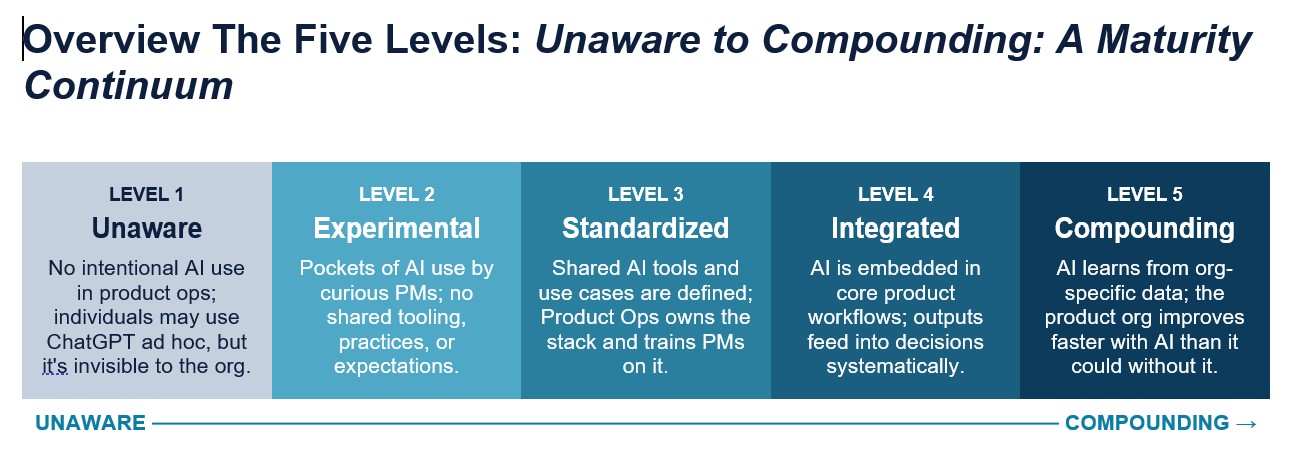
The five levels represent a progression from unconscious disuse to self-reinforcing organizational intelligence. Each level is defined not just by tools adopted, but by how deeply AI is woven into the operating rhythm of the product team.
- Level 1 (Unaware): Product operations run entirely on manual effort. Feedback is read individually. Prioritization reflects whoever speaks loudest. Product Requirement Documents (PRDs) are blank-page exercises. There is no data on whether the team is using AI at all because no one is asking.
- Level 2 (Experimental): Curiosity has arrived, but coordination has not. Individual PMs are finding value in AI tools, but their discoveries don't circulate. There is no shared prompt library, no standard tooling, no expectation that anyone else is doing the same thing.
- Level 3 (Standardized): Product Operations takes ownership. AI use cases are defined, tooling is approved, templates exist, and PMs are trained. The wild improvisation of Level 2 has been replaced by repeatable practice. The floor has risen for the whole team.
- Level 4 (Integrated): AI is no longer a tool people reach for it is built into the workflow. Discovery artifacts automatically generate PRD drafts. Prioritization frameworks ingest live OKR and customer data. The product cycle accelerates without extra headcount.
- Level 5 (Compounding): The organization has created something proprietary: a feedback loop in which AI trained on organizational history makes each cycle faster and sharper than the last. This is no longer productivity enhancement it is a structural advantage that grows over time.
The Five Dimensions
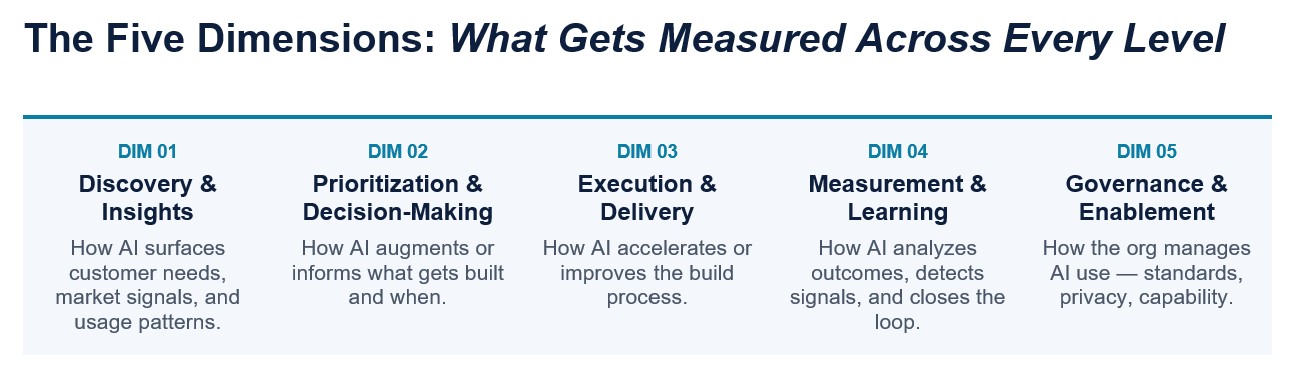
The framework is intentionally multi-dimensional because AI maturity doesn't move uniformly. An organization might have a highly sophisticated measurement practice and still be at Level 1 for governance.
- Discovery & Insights covers the front end of the product cycle how signals are collected, synthesized, and acted upon. Mature AI use here means the team never falls behind what customers are telling them.
- Prioritization & Decision-Making addresses the chronic PM challenge of justifying the right work at the right time. AI augmentation here replaces opinion-based prioritization with evidence-backed, simulation-informed trade-off analysis.
- Execution & Delivery measures how effectively AI reduces the cost of translating decisions into specifications. At higher levels, AI generates first drafts, links requirements to test cases, and automates stakeholder communication.
- Measurement & Learning tracks how well the team closes the loop between what was built and what was learned. AI here evolves from dashboard assistant to anomaly detector to closed loop learning engine.
- Governance & Enablement is often the last dimension organizations invest in and frequently the one that limits progress in all the others. Governance defines what's permitted, what data is protected, which tools are approved, and whether AI capability is developed intentionally across the PM team.
The Experimental Level: Why It Matters
I’ve experienced 1st hand many organizations operating at Level 2 Experimental in their Product Operations. Pockets of AI use exist among curious PMs, but there is no shared tooling, no common practices, and no organizational expectations. Individual gains are real, but they are invisible and non-transferable. This is where the maturity journey either takes root or stalls.
In our work with product organizations, we find teams operating at Level 2 not because their people are not capable, but because the organization hasn't yet put the conditions in place for that capability to grow and spread.
The Experimental level is a pivotal moment. Product Owners and Product Managers who are experimenting with AI are building muscle memory, developing judgment about what works, and discovering which use cases deliver real value. The risk is that this learning stays siloed.
Understanding how each dimension is exercised at the Experimental level, what practices look like, what the impacts are, and where AI integration delivers the most visible early returns gives Product Operations a clear picture of what to capture, codify, and scale.
How Level 2 Experimental Can be Exercised Across Each Domain
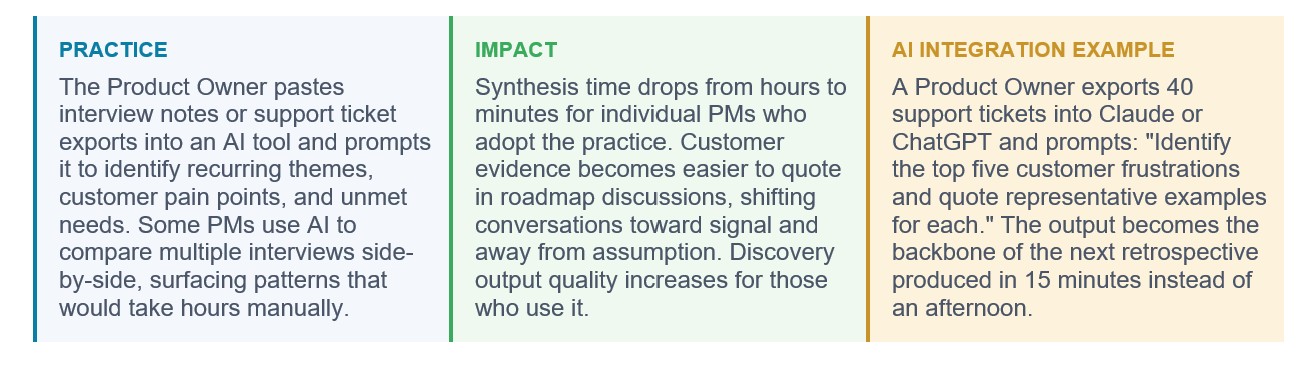
01 Discovery & Insights - How AI surfaces customer needs, market signals, and usage patterns
At the Experimental level, Discovery shifts from fully manual synthesis to individual-initiated AI assistance. Rather than reading through customer interviews and support tickets unassisted, individual Product Owners begin using AI tools to compress and surface themes from qualitative feedback. This is not systematic, it depends entirely on the PM's initiative, but it marks the first meaningful departure from purely manual insight generation.
AI Integration Example:
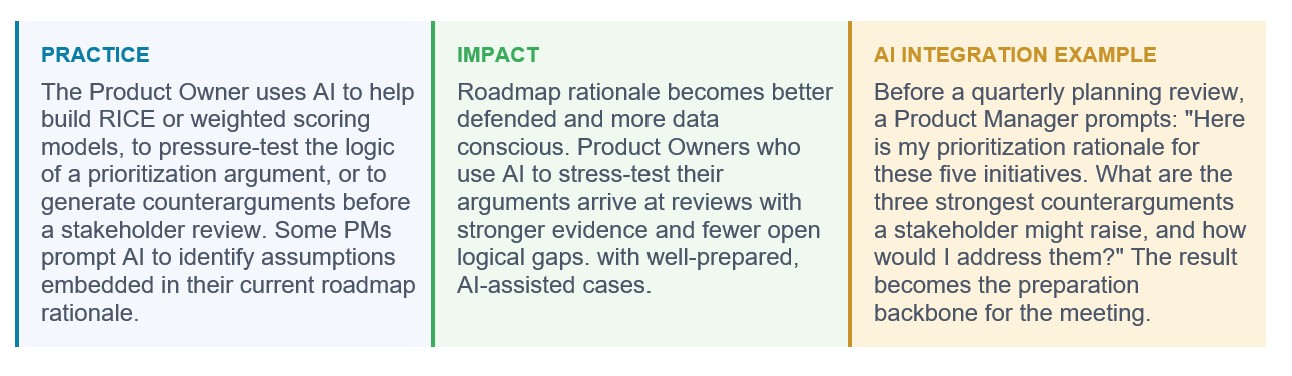
02 Prioritization & Decision-Making - How AI augments or informs what gets built and when
At Level 2, prioritization practices begin to gain analytical rigor. Rather than relying solely on stakeholder influence or intuition, some Product Owners experiment with AI to draft or critique scoring models, stress-test their reasoning, and anticipate objections before roadmap reviews. This is still individual rather than coordinated but the direction of travel is meaningful.
AI Integration Example:
03 Execution & Delivery - How AI accelerates or improves the build process
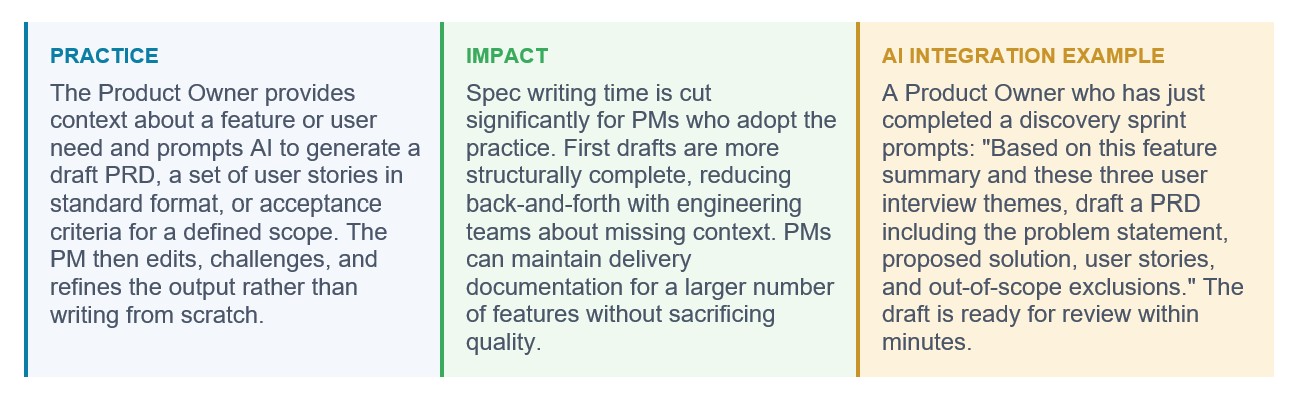
Execution is often where individual PMs first notice a material productivity gain from AI, because the tasks involved, writing specs, drafting user stories, and articulating acceptance criteria are time-consuming and well-suited to AI assistance. At the Experimental level, individual Product Owners begin using AI to generate first drafts of these artifacts, dramatically reducing the blank-page cost of delivery documentation.
AI Integration Example:
04 Measurement & Learning - How AI analyzes outcomes, detects signals, and closes the loop
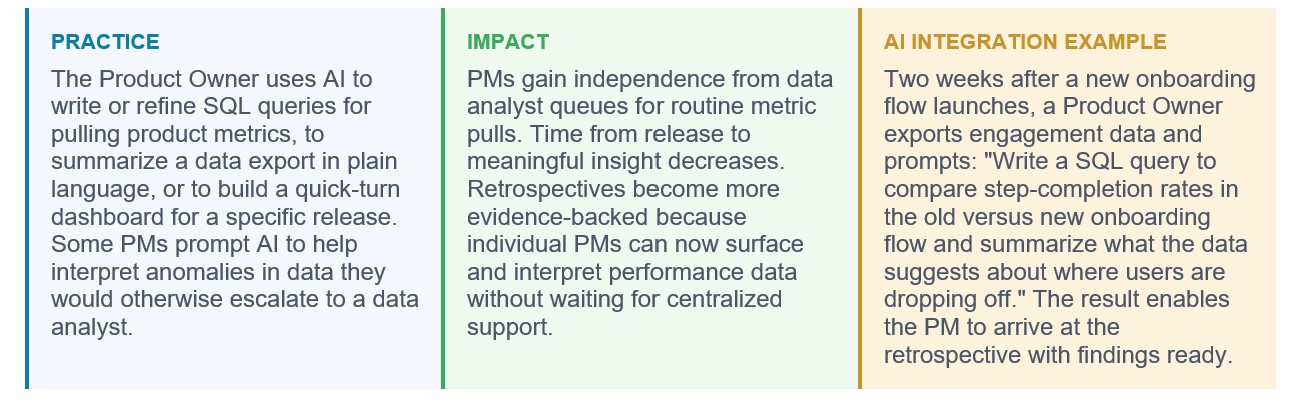
At Level 2, Measurement evolves from quarterly manual reviews into something more responsive and accessible. Individual PMs experiment with using AI to write SQL queries for data analysis, to build dashboards faster, or to generate automated summaries of recent performance data. The loop between release and learning begins to close more quickly.
AI Integration Example:
05 Governance & Enablement - How the org manages AI use standards, privacy, and capability
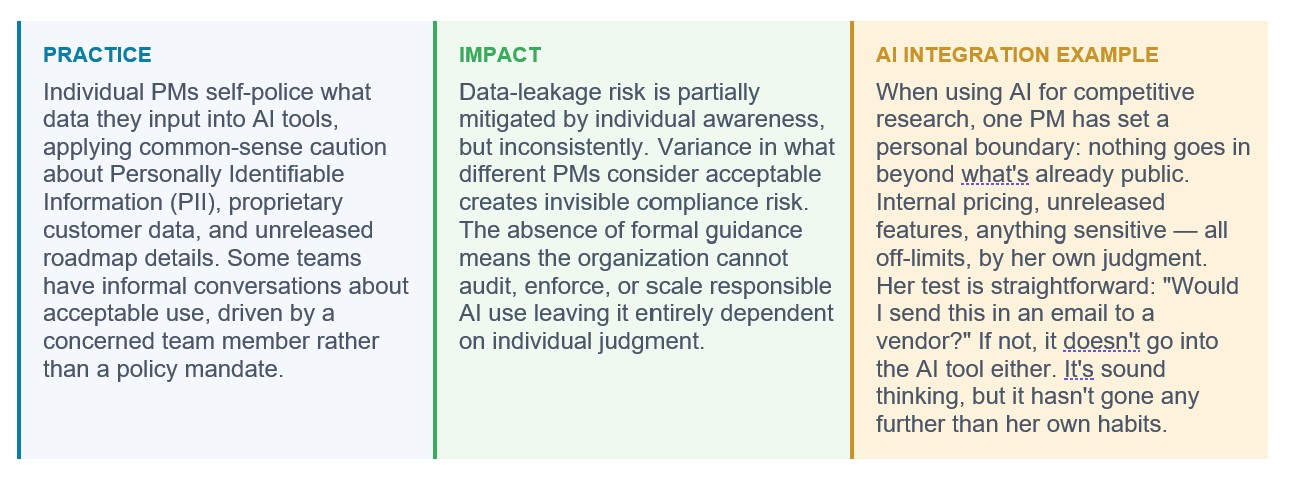
Governance at the Experimental level is informal but not entirely absent. Product Owners and Managers who have been exploring AI tools begin developing a personal awareness of what should and should not be shared with public AI systems. Some informal guidance starts circulating but it has not been formalized into policy, approved tooling lists, or organizational training.
In Summary: The Choices You Make Today Shape Tomorrow's Team
Individual Product Owners and PMs who have found personal productivity gains with AI tools are demonstrating exactly the kind of curiosity and initiative that drives organizational improvement.
But curiosity without structure does not scale. What the Experimental level reveals across every dimension is the consistent gap between individual discovery and organizational capability.
The move from Experimental to Standardized is not about adopting more tools. It is about deciding that the gains being quietly discovered by individual product people are worth preserving, sharing, and building upon. That decision is a Product Operations decision and it's one of the highest-value investments a product organization can make.
AKF Partners uses this Product Operations framework as a diagnostic tool across client engagements. If your product organization wants to understand where it stands and what the next concrete moves are, please Contact Us