
Artificial intelligence is no longer a future capability for product organizations building software products — it is a present-day competitive necessity. The question is no longer whether product teams should use AI, but how deliberately and systematically they are doing so.
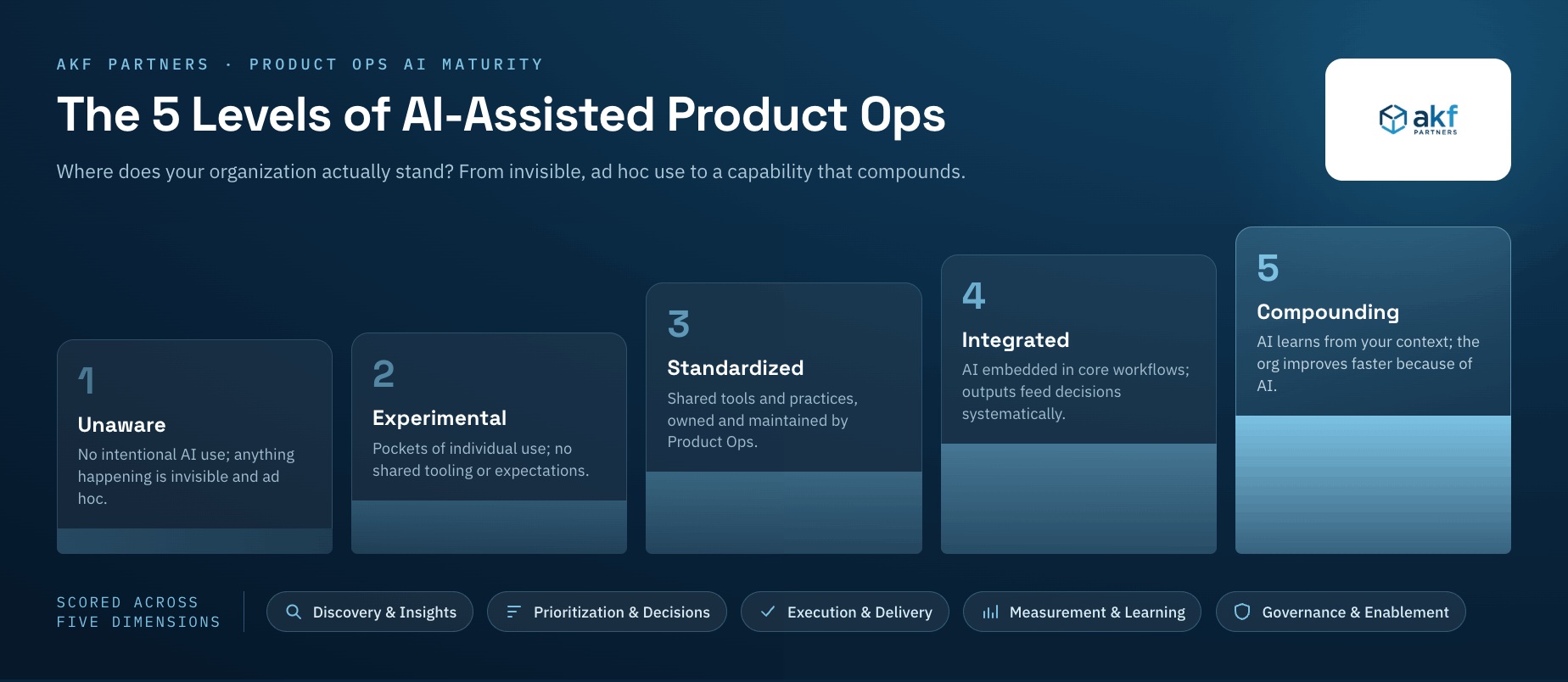
At AKF Partners, we have developed a framework that allows software product companies to assess where they genuinely stand in their use of AI across product operations, and to identify clear, actionable steps to advance. The framework is built around five dimensions of product operations activity and five levels of maturity within each.
Because organizations are rarely uniform in their adoption — a company might be surprisingly advanced in how it uses AI for discovery while remaining almost entirely manual in how it governs AI use — the framework is designed to surface that unevenness and help leadership prioritize accordingly.
The Five Dimensions
The framework assesses AI use and effectiveness across five dimensions that map to the core activities of a product organization:
- Discovery & Insights — How AI is used to surface customer needs, market signals, and usage patterns
- Prioritization & Decision-Making — How AI augments or informs what gets built and when
- Execution & Delivery — How AI accelerates or improves the build process
- Measurement & Learning — How AI is used to analyze outcomes and close the feedback loop
- Governance & Enablement — How the organization manages AI use, tooling, data privacy, and PM capability
The Five Levels
Across every dimension, maturity progresses through five levels:
A useful way to picture this progression is the history of finding your way from one place to another. At Level 1 there is no map at all — you rely on memory and instinct. By Level 2, a few people sketch their own routes by hand: helpful, but private and inconsistent. At Level 3 the organization adopts a shared road atlas, so everyone navigates the same way. At Level 4 the map moves into the dashboard as live GPS, rerouting automatically as conditions change. And at Level 5 it becomes Waze — every trip every person takes feeds back into the system, so the routes get smarter the more the organization uses them. That is the difference at the top of the scale: the capability compounds.
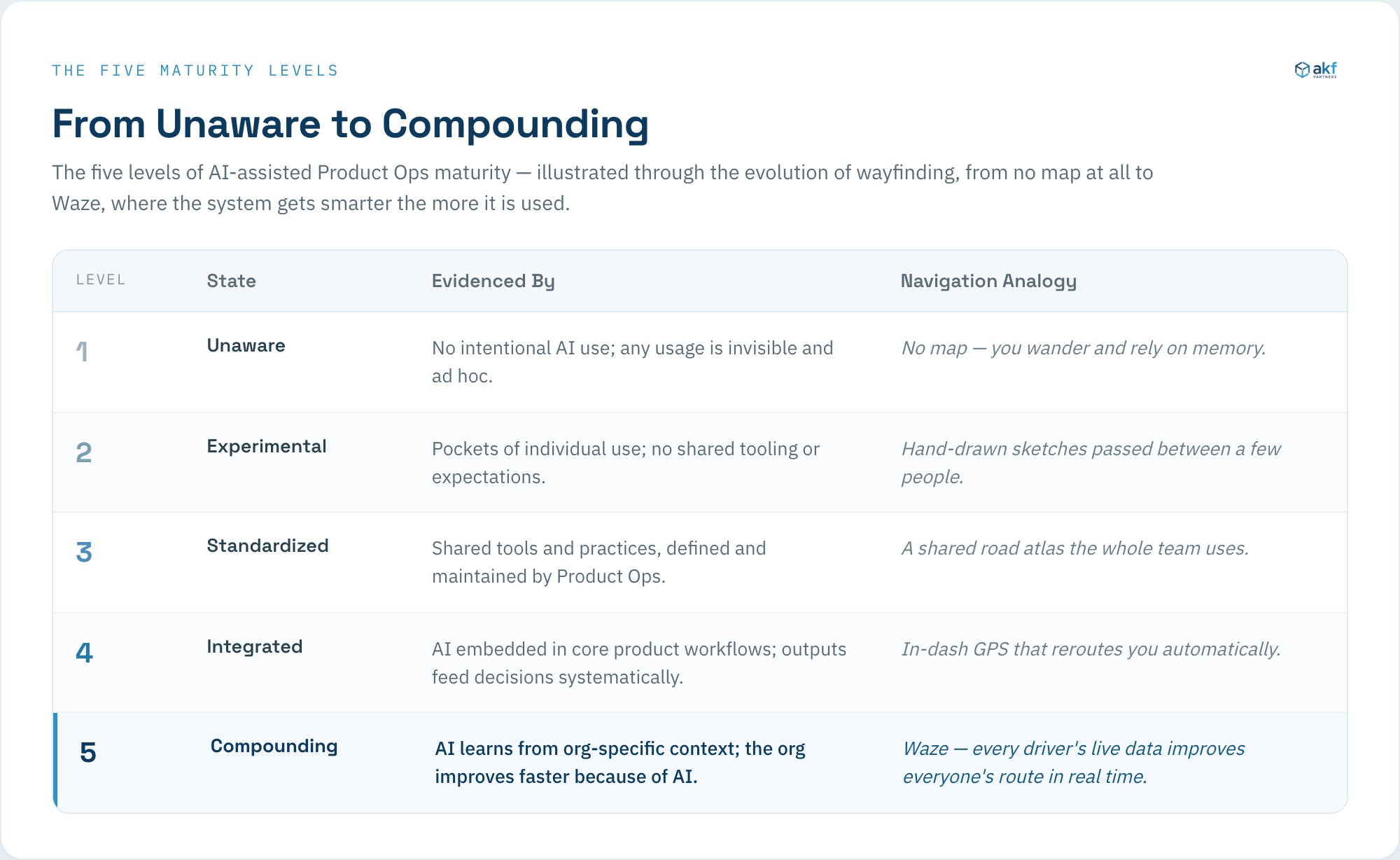
Figure 1. The five maturity levels, illustrated through the evolution of wayfinding — from no map at all, to a shared atlas, to Waze, where the system gets smarter the more it is used.
Dimension 1: Discovery & Insights
Discovery is the lifeblood of product development. It is how product teams understand who they are building for, what those people actually need, and where the greatest unmet opportunities lie. It encompasses everything from customer interviews and usability testing to support ticket analysis, NPS data, churn reasons, behavioral analytics, and market research.
AI has the potential to transform discovery from a periodic, resource-intensive activity into a continuous and scalable one. The question is whether organizations are using it that way.
Level 1 — Unaware
At Level 1, discovery is entirely manual and largely episodic. Customer interviews are conducted when bandwidth allows. Feedback from support tickets, sales calls, and NPS surveys accumulates in various systems but is rarely synthesized in a systematic way. Individual PMs may hold deep knowledge about their specific customers, but that knowledge is not shared, documented, or made accessible across the product organization.
There is no use of AI to assist with any part of this process. The primary risk at this level is that signal is highly dependent on individual effort and attention, is not scalable as the organization grows, and introduces significant inconsistency in how different product areas are informed.
Level 2 — Experimental
At Level 2, individual product managers have begun to use AI tools to assist with parts of the discovery process, but there is no coordination, standardization, or organizational visibility into these practices. A senior PM might use an AI tool to synthesize notes from a set of customer interviews. A product analyst might run customer feedback through an AI summarization tool to identify themes.
These experiments are genuinely useful at the individual level, but the organization does not benefit systematically. AI use in discovery is also largely reactive — it is applied to work that has already been gathered, rather than changing how discovery is structured or conducted.
Level 3 — Standardized
At Level 3, Product Operations has taken ownership of AI-assisted discovery as a practice. There are shared tools and PMs across the organization are trained on and expected to use them. Common practices at this level include:
- A standard approach to processing customer interview recordings or transcripts through AI to extract themes, quotes, and unmet needs
- Regular AI-assisted analysis of support tickets and NPS verbatims to surface emerging patterns and track sentiment trends
- A shared feedback repository where inputs from multiple channels are centralized and processed through AI to generate a unified view of customer priorities
The critical shift at Level 3 is that discovery insights become more consistent, more comparable across teams, and more accessible to stakeholders who were not present for the original research.
Level 4 — Integrated
At Level 4, AI is not just processing discovery outputs — it is embedded in the ongoing listening infrastructure of the organization. Feedback channels are continuously monitored, and AI surfaces emerging themes, sentiment shifts, and potential signals in near real time rather than waiting for a PM to initiate an analysis.
- An always-on system that monitors incoming support tickets, app store reviews, community forums, and social channels, automatically categorizing feedback by product area
- AI-assisted post-interview processing integrated into the interview scheduling and recording workflow, so synthesis happens automatically within hours
- Integration between customer feedback systems and the product roadmap tool, linking themes from discovery directly to roadmap items
Level 5 — Compounding
At Level 5, AI-powered discovery is not just continuous — it is predictive and proprietary. The organization has built systems that learn from its specific customer base, product context, and historical data in ways that general-purpose AI tools cannot replicate.
- Models trained on years of the organization's own customer interview data, NPS responses, and behavioral analytics that can identify patterns and predict emerging needs
- AI systems that connect behavioral signals with qualitative feedback to generate a richer picture of unmet needs than either source could provide alone
- The ability to identify segments of customers likely to churn, expand, or become advocates based on behavioral patterns
At Level 5, the discovery capability itself becomes a competitive advantage.
Dimension 2: Prioritization & Decision-Making
Prioritization is one of the most consequential — and most contested — activities in product management. It is where strategy meets reality, where trade-offs are made explicit, and where the allocation of engineering, design, and product capacity is determined. It is also, historically, one of the most susceptible to politics, cognitive bias, and the influence of whoever is most vocal in the room.
AI does not eliminate the human judgment required for good prioritization, but it can substantially improve the quality of inputs, the consistency of the process, and the ability to stress-test decisions before committing to them.
That human judgment should be applied through four base lenses for each candidate feature: usability, or whether a human or agent can successfully interact with the capability; feasibility, or whether the organization can build and maintain it reliably; viability, or whether the broader business can sell, market, operate, and support it; and value, or whether customers will pay for it or otherwise reward the company for delivering it. AI can help structure and inform these assessments, but the judgment of how to weigh the trade-offs remains a leadership responsibility.
Level 1 — Unaware
At Level 1, prioritization is driven primarily by a combination of executive intuition, stakeholder pressure, and individual PM judgment. Frameworks like RICE, ICE, or MoSCoW may exist on paper, but they are applied inconsistently or not at all. The loudest voice in the room has disproportionate influence on what gets built.
The backlog accumulates items that reflect individual relationships and vocal stakeholders rather than customer impact. Product strategy is difficult to defend or explain because the decision-making process lacks transparency and rigor.
Level 2 — Experimental
At Level 2, individual PMs are beginning to use AI tools to assist with parts of the prioritization process. This might include using an AI model to help build or populate a scoring framework, asking AI to generate counter-arguments to a prioritization decision, or using AI to draft a summary of the customer evidence behind a particular roadmap item.
These uses are genuinely helpful but remain ad hoc. The organizational prioritization process remains largely unchanged.
Level 3 — Standardized
At Level 3, Product Operations has defined a standard approach to AI-assisted prioritization. This typically includes:
- Shared templates for scoring frameworks (RICE, WSJF) pre-populated with AI-generated estimates for reach, effort, and strategic alignment
- A standard practice of using AI to generate a structured summary of customer evidence, business case, and known risks for each significant roadmap item
- Prompt libraries that help PMs generate alternative perspectives — for example, prompting AI to argue the case for deprioritizing an item, or to identify what assumptions the current prioritization relies on
PMs arrive at prioritization discussions better prepared, with more structured supporting evidence, and with a clearer articulation of trade-offs.
Level 4 — Integrated
At Level 4, AI is embedded in the prioritization workflow itself, with access to OKRs, roadmap items, customer feedback themes, usage analytics, revenue data, and effort estimates. Examples include:
- AI-generated quarterly planning documents that cross-reference the current backlog against OKR progress and flag misaligned items
- Automated effort estimation inputs generated from engineering data and historical delivery patterns
- AI that monitors OKR progress in real time and proactively flags when current roadmap priorities appear unlikely to move the relevant metrics
Level 5 — Compounding
At Level 5, the organization has built a dynamic prioritization capability where AI continuously re-evaluates the relative value of roadmap items as new signals arrive. Rather than a static document reviewed quarterly, the roadmap becomes a living prioritization surface that reflects the current best understanding of customer impact, strategic alignment, and delivery feasibility at all times.
Organizations at this level also use AI to model the downstream effects of prioritization decisions — simulating the likely impact on key metrics for different roadmap configurations — and incorporating those models into decision-making.
Dimension 3: Execution & Delivery
Execution is where product strategy becomes product reality. It encompasses the full set of activities that translate a prioritized roadmap item into a shipped feature: writing PRDs, defining user stories and acceptance criteria, conducting design reviews, managing the product-to-engineering handoff, coordinating sprint ceremonies, and managing stakeholder communication throughout delivery.
This dimension has attracted more attention from AI vendors than perhaps any other, because the artifacts of execution are text-based and therefore well-suited to AI generation. The risk is that organizations adopt AI for execution without the governance and quality standards to ensure that AI-generated artifacts are actually useful rather than merely voluminous.
Level 1 — Unaware
At Level 1, all execution artifacts are produced manually. PRDs are written from scratch by individual PMs, with significant variation in structure, depth, and quality across the organization. User stories and acceptance criteria are created in whatever format the individual PM or engineering team prefers.
The costs are significant even if largely invisible: PMs spend a large proportion of their time on documentation rather than discovery and strategy; engineering teams waste time seeking clarification on ambiguous requirements; and institutional knowledge about why particular decisions were made is frequently lost.
Level 2 — Experimental
At Level 2, individual PMs have begun to use AI to accelerate the production of execution artifacts. They may use AI to generate a first draft PRD, convert discovery notes into user stories, generate acceptance criteria, or draft stakeholder updates and release notes.
The productivity gains can be substantial for individuals who have developed effective practices, but the quality of AI-generated artifacts varies widely, and there is no organizational standard for what constitutes acceptable AI-generated output.
Level 3 — Standardized
At Level 3, Product Operations has established standards for AI-assisted execution covering both tooling and quality expectations:
- Standard PRD and user story templates designed to work effectively with AI generation, specifying structure, required detail level, and the information inputs the PM must provide
- A prompt library for common execution artifacts — PRDs, user stories, acceptance criteria, release notes, stakeholder updates — tested and refined for reliably useful outputs
- A review and quality standard for AI-generated artifacts, specifying that AI-generated acceptance criteria must be reviewed against the engineering team's definition of done before a ticket enters a sprint
- Training for PMs on effective AI use for execution, including common failure modes such as hallucinated requirements and acceptance criteria that are technically untestable
Level 4 — Integrated
At Level 4, AI assistance is available in context within the tools that PMs and engineering teams actually use, rather than requiring a separate interaction with an AI tool outside the workflow:
- AI automatically generates a draft PRD structure from a discovery artifact or customer feedback theme, within the product management tool
- Integration between the specification tool and the engineering ticket system, so acceptance criteria propagate automatically without manual copy-paste
- AI-assisted sprint planning that reviews tickets against the original acceptance criteria and flags any missing key information before the sprint begins
- Automated generation of stakeholder-appropriate summaries of sprint progress, tailored to different audiences based on the underlying delivery data
Level 5 — Compounding
At Level 5, AI agents take on portions of the delivery coordination workflow — handling routine administrative and communication tasks that currently consume significant PM time:
- AI agents that monitor the delivery workflow, proactively surface blockers, flag items at risk of missing their committed date, and draft communications to relevant stakeholders
- Automated detection of scope creep — AI compares the current state of a specification against its original version and flags significant additions or changes that may affect the delivery timeline
- AI-assisted retrospective synthesis that identifies patterns across multiple sprint retrospectives and surfaces systemic issues in the delivery process
Dimension 4: Measurement & Learning
The ability to measure the outcomes of product decisions and to learn systematically from those outcomes is what separates high-performing product organizations from those that merely ship features. Without a rigorous measurement and learning capability, teams build on hope rather than evidence — they cannot tell whether what they built actually moved the metrics that matter.
AI has significant potential to improve measurement and learning, both by making it easier to analyze the data that organizations already collect and by surfacing insights and anomalies that human analysts would miss in the volume and complexity of modern product data.
Level 1 — Unaware
At Level 1, measurement is largely retrospective and infrequent. Metrics are reviewed in quarterly business reviews, typically compiled manually in the week before the meeting. There is no systematic connection between feature releases and outcome measurement — the question 'did this feature actually achieve what we hoped?' is rarely answered rigorously.
Retrospectives focus on delivery process rather than outcome learning. The organizational memory of what has been tried, what worked, and what did not is held in the heads of individual PMs rather than in any systematic knowledge management practice.
Level 2 — Experimental
At Level 2, individual PMs or analysts are beginning to use AI tools to make data analysis more accessible and efficient — using AI to write SQL queries, generate dashboards from data, or produce narratives from analytics outputs. Some teams may use AI to structure and analyze retrospective data.
These uses lower the technical barrier to data analysis and make it possible for PMs without strong data skills to access and interpret product metrics more independently. The limitation is that insights generated by individual AI-assisted analyses are not systematically shared or retained.
Level 3 — Standardized
At Level 3, Product Operations has established a standard measurement and learning practice that incorporates AI assistance in defined ways:
- Standard metrics frameworks for each product area, with consistent definitions and AI-assisted dashboards updated automatically and distributed to relevant stakeholders on a regular cadence
- A standard approach to experiment analysis using AI to generate structured interpretation of A/B test results, including statistical significance, effect size, and recommended next steps
- AI-assisted retrospective formats that use structured sprint data to generate a baseline analysis before the team meeting, so discussions focus on interpretation and action rather than data assembly
- Documentation of product decisions with AI-generated summaries capturing the evidence considered, the decision made, and the metrics that will evaluate success
Level 4 — Integrated
At Level 4, measurement and learning are embedded in the product development workflow as continuous activities rather than periodic events. AI monitors product metrics, experiment results, and customer signals in real time:
- Automated anomaly detection that flags unusual patterns in key metrics and routes alerts to the PM with a structured analysis of likely causes
- Integration between experiment tooling and the product management platform, so A/B test results surface automatically in the context of the relevant roadmap item with AI-generated interpretation and recommendation
- AI-assisted attribution analysis that attempts to connect specific feature releases to movement in outcome metrics, accounting for confounding factors and surfacing confidence levels for each attribution
Product organizations develop a much faster and more reliable feedback loop — learning whether their investments are working not at the end of the quarter but within days or weeks of a release.
Level 5 — Compounding
At Level 5, measurement and learning are connected to discovery and prioritization in a closed loop. AI does not just report on outcomes — it feeds findings back into the ongoing discovery and prioritization process, so that what the organization learns from measuring one set of decisions directly informs the next set:
- AI systems that connect outcome data from completed features with the original customer signals that motivated them, evaluating whether the feature delivered on the underlying customer need
- Predictive models that use historical delivery and outcome data to improve the accuracy of future effort estimates and outcome predictions
- Organizational learning systems that synthesize insights across multiple retrospectives, post-mortems, and experiment results to identify systematic patterns
Dimension 5: Governance & Enablement
Governance and enablement is the dimension that makes the other four sustainable. An organization can achieve impressive results in discovery, prioritization, execution, and measurement through individual AI experimentation, but it cannot scale those results, manage the associated risks, or compound the organizational capability without deliberate governance and a systematic investment in PM capability.
Done well, governance and enablement is not a constraint on AI adoption but an accelerant: it creates the confidence to go further and faster because the risks are understood and managed.
Level 1 — Unaware
At Level 1, there is no policy, guidance, or organizational awareness of AI use in product operations. Individual PMs may be using AI tools in their personal workflow, but this is invisible to the organization. Sensitive information — customer data, unreleased product plans, proprietary research — may be being entered into public AI tools without any awareness of the data privacy and confidentiality implications.
The organization is operating with the benefits and risks of AI adoption without any of the infrastructure to manage either.
Level 2 — Experimental
At Level 2, there is growing awareness of AI use within the product organization, and some informal guidance has been communicated — typically in response to an incident or a concern raised by legal or security. PMs are aware at a general level that they should not enter customer PII or sensitive commercial information into public AI tools, but this guidance is not formalized, trained, or enforced.
Some leaders are beginning to explore the question of AI tooling more systematically, but no decisions have been made and no investment has been committed.
Level 3 — Standardized
At Level 3, Product Operations has taken ownership of AI governance and enablement as a formal responsibility:
- A written AI use policy specifying which tools are approved, what categories of information can and cannot be entered into AI tools, and what the review and quality standards are for AI-generated work product
- An approved tooling stack, evaluated for data privacy, security, and fitness for purpose — with a clear rationale for each tool and a process for requesting additions or exceptions
- A prompt library and knowledge base, maintained by Product Ops, that captures effective prompts and AI-assisted workflows for the most common PM tasks
- Onboarding and training for new PMs that includes AI tool usage, the approved tooling stack, and the quality standards for AI-generated work
Level 4 — Integrated
At Level 4, AI governance and enablement are treated as ongoing organizational capabilities rather than one-time setup activities. PM AI capability is assessed as part of performance review and development planning:
- Regular audits of AI tool usage to ensure compliance with the data use policy and to identify emerging use cases that should be formalized or supported
- A PM AI capability framework that defines expected AI proficiency at each PM level, with structured development resources accordingly
- Formal vendor risk management for AI tools, including evaluation of training data practices, data retention policies, and security certifications
- An AI governance committee or working group with representation from Product, Legal, Security, and Engineering, meeting regularly to review policy and evaluate new tools
Level 5 — Compounding
At Level 5, AI governance and enablement are strategic capabilities that contribute to the organization's competitive position. The organization is not just managing AI risk but actively building proprietary AI capability:
- Investment in proprietary AI infrastructure — for example, a custom retrieval-augmented generation system that allows PMs to query against the organization's own customer research, product history, and decision documentation
- A PM development program that produces PMs recognized externally as leaders in AI-augmented product practice — creating a talent advantage
- AI capability as a formal input to product strategy — the organization's ability to build AI-powered products is informed by, and in some cases enabled by, the AI practices it has developed in its product operations
The organizations that will have a durable advantage in product development over the next decade are not necessarily those that adopt AI earliest, but those that adopt it most systematically and deliberately. Individual AI experimentation creates individual productivity gains. Organizational AI maturity creates compounding capability — the kind that gets faster, smarter, and more differentiated over time.
The AKF AI Maturity Framework for Product Operations provides a structured way to assess where you are, understand what the next level looks like, and make deliberate investments to get there. Whether you are a CPO or CPTO trying to understand your organization's current state, a Product and Engineering Ops leader building a practice, or a board or executive team evaluating product capability, the framework gives you a common language and a clear map.
The goal is not to achieve Level 5 across all dimensions simultaneously — that is neither realistic nor necessarily the right priority for every organization at every stage. The goal is to be intentional: to understand your current state honestly, to prioritize the right investments, and to build AI capability in product operations as deliberately as you would build any other strategic capability.