
In many software organizations, the Center of Excellence (CoE) has become a cornerstone of scaling expertise and accelerating change across the broader Product Engineering organization. Whether it’s a DevOps CoE improving deployment velocity, a Security CoE hardening systems against emerging threats, or an Agile CoE driving better delivery practices, the best CoEs share one thing in common: they don’t just advise—they DO.
In many software organizations, the Center of Excellence (CoE) has become a cornerstone of scaling expertise and accelerating change across the broader Product Engineering organization. Whether it’s a DevOps CoE improving deployment velocity, a Security CoE hardening systems against emerging threats, or an Agile CoE driving better delivery practices, the best CoEs share one thing in common: they don’t just advise—they DO.
Too often, CoEs risk drifting into theoretical spaces—producing frameworks, governance models, and endless slide decks that live in a vacuum. High-performing CoEs are something different: they’re embedded, active, hands-on contributors who lead by doing and elevate everyone around them.
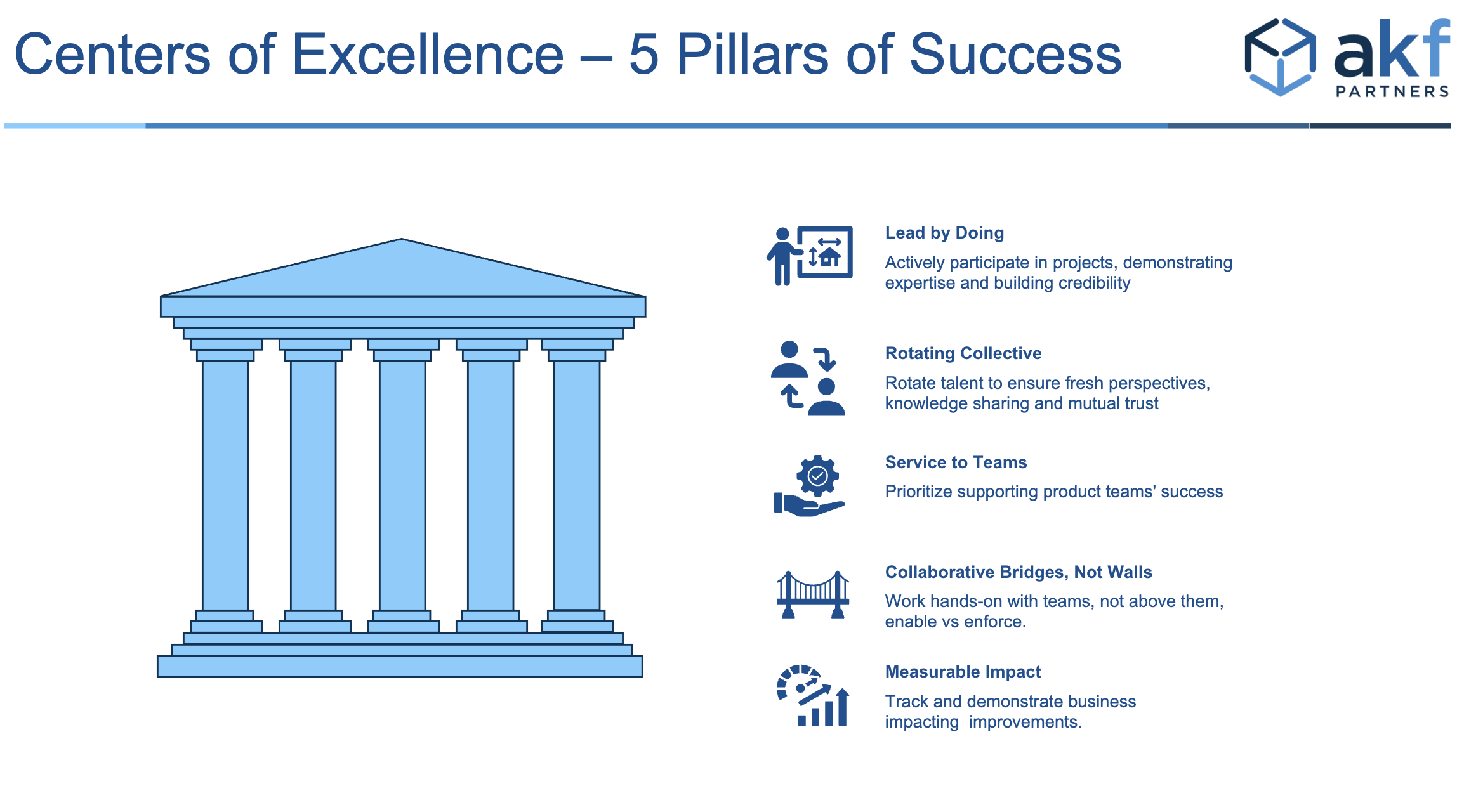
Let’s go inside what makes these high-performing CoEs thrive. Across dozens of product engineering organizations, five core principles stand out as the difference between a CoE that merely exists—and one that truly accelerates excellence.
1. Principle One: Lead by Doing, Not Just Advising
At their best, Centers of Excellence are force multipliers. But they can’t multiply what they don’t themselves practice.
The most effective CoEs roll up their sleeves. They prototype, pair, run pilots, and deliver value directly into production systems. They’re the ones who deploy the first iteration of a new CI/CD pipeline, implement the reference IaC pattern, or demonstrate a secure code review in a live sprint.
“The CoE must be known as the team that gets things done—not the team that writes policies about getting things done.”
When a CoE only advises, the rest of the organization tunes out. Recommendations become theoretical and disconnected from ground realities. But when a CoE builds and ships alongside teams, its guidance gains immediate credibility.
Hands-on involvement also keeps the CoE’s expertise current. Technology and practices evolve fast—being embedded in delivery work ensures the CoE remains anchored in real problems, tools, and workflows.
How to make it real:
- Pair up with stream-aligned delivery teams: Run joint sprints to implement a proof of concept or new capability.
- Publish working capabilities, not just standards including examples such as repositories, templates, pipelines and dashboards.
- Create a “Dojo” model: Invite teams in for short, immersive engagements where CoE team members coach by coding and build side by side.
2. Principle Two: Operate as a Rotating Collective, Not a Permanent Ivory Tower
A high-performing CoE is dynamic, not static. It rotates talent in and out, maintaining a flow of fresh perspectives, skills, and organizational empathy.
When a CoE becomes a permanent enclave, its members risk losing touch with the day-to-day struggles of product teams. Their advice becomes dated, their empathy fades, and the trust that once made them influential begins to erode.
Rotations, on the other hand, create a two-way learning exchange. Members bring frontline insights into the CoE—and take best practices, standards, and automation patterns back out into their home teams.
Benefits of rotation:
- Knowledge cross-pollination: Ideas and techniques flow naturally across teams.
- Career growth: Rotation builds technical breadth and leadership skills.
- Organizational alignment: CoE members stay connected to what the business actually needs.
Implementation ideas:
- ~12 month rotations for engineers and architects.
- Hybrid staffing models—core CoE members for continuity, rotational contributors for fresh input.
- Practice exit and entry rituals: Document learnings, run retros, and ensure knowledge continuity.
3. Principle Three: Be in Service to the Teams
The CoE exists to serve, not to control.
High-performing CoEs view product teams as their customers. Their success metrics aren’t framework adoption or policy compliance—they’re improved outcomes for the teams they support: faster delivery, fewer security incidents, higher test coverage, better developer satisfaction.
This service mindset fundamentally changes tone and behavior. Instead of “thou shalt,” it becomes “how can we help?”
“A great CoE doesn’t hand down mandates. It earns trust through partnership, responsiveness, and reliability.”
What service-oriented looks like:
- On-demand enablement: Rapid response to requests for help configuring, debugging, or improving processes.
- Office hours and support channels: Dedicated Slack threads or weekly sessions for coaching and Q&A.
- Tooling and automation as self-service: Build reusable modules, CI/CD templates, and guardrails that empower teams instead of slowing them down.
4. Principle Four: Build Collaborative Bridges, Not Compliance Walls
The term “Center of Excellence” can unintentionally suggest centralization and control. But excellence isn’t enforced—it’s enabled.
High-performing CoEs succeed because they foster collaboration, shared ownership, and transparency. They work with teams, not above them.
Instead of dictating processes, they co-create standards. Instead of performing audits, they participate in design reviews. Instead of delivering top-down directives, they invite contributions to shared frameworks and patterns.
Practical collaboration habits:
- Shared backlogs: Allow teams to submit requests or suggest improvements directly into the CoE’s queue.
- Working groups: Cross-functional pods for key topics (e.g., test automation, observability, supply chain security).
- Open source internally: Treat CoE artifacts—scripts, dashboards, docs—as open projects with PRs and peer reviews.
5. Principle Five: Anchor on Measurable Impact and Continuous Learning
A CoE must prove its value not through presentation decks, but through measurable outcomes.
Every initiative should answer: What measurable improvement are we driving in product delivery, quality, or security?
A DevOps CoE might track deployment frequency, lead time, and mean time to recovery. A Security CoE might measure vulnerability closure rate or percentage of code covered by automated scanning. An Agile CoE might focus on predictability and flow efficiency.
Without evidence, even the best intentions lose credibility. Metrics create focus, validate priorities, and provide feedback loops for learning.
How to embed continuous learning:
- Run retros on CoE initiatives, not just delivery sprints.
- Publish quarterly learning reports: What worked, what didn’t, what’s next.
- Celebrate incremental wins: Small, sustained improvements build momentum.
A great CoE is not a gatekeeper—it’s a catalyst.
It lives at the intersection of thought leadership and practical execution, constantly balancing its advisory role with hands-on contribution. It creates value not by owning excellence, but by enabling it throughout the organization.
The result? A CoE that’s respected, embedded, and indispensable—one that drives transformation not from the sidelines, but from the heart of the product organization.
For more on CoE’s in the context of organizational and operational models, check out our previous post on this topic. AKF works with teams regularly to optimize their organization structure for scale. Call us and we can help!